Commentary: Trek Stars 52: Chasing Tires by TFM

Black & Cushman, Part 1: Star Trek & These are the Voyages.

These are the Voyages has quickly become the most critically acclaimed book ever written on the making of Star Trek. It is a comprehensive look at the day-to-day operation of The Original Series, from script to air.

In the second season finale, Max and Mike are joined by the book's author and Next Generation writer Marc Cushman, Original Series writer and producer John D.F. Black, and his wife and Original Series assistant, Mary Black. We discuss what makes this book different from others, what it was like to work on The Original Series, and how the industry has changed over the years. We also try to figure out how you can tell when a writer is lying about missing a deadline.

These are the Voyages, TOS, Season One can be purchased now on Amazon.com, with Seasons Two and Three set for release in the coming months.
cts-052-th-720.jpg

Commentary: Trek Stars 51: The Future of Cancelled Sci-Fi TV by TFM

Moore, Part 7: Recap.

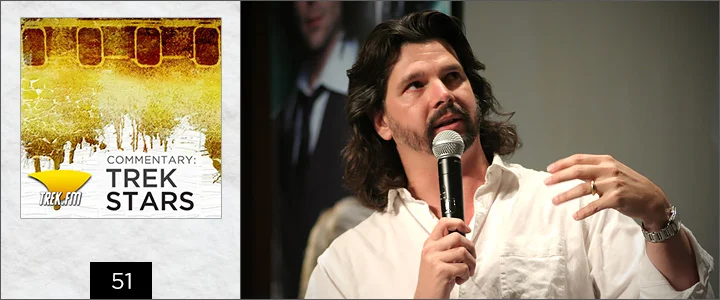
Ronald D. Moore's work as a writer on Star Trek gained the attention of many producers in Hollywood. Because of this, he has built a very successful career as a television showrunner.

This week, Mike and Max recap their series on Moore's career, looking at all of the shows he ran, including Roswell, Carnivale, Battlestar Galactica, Caprica, and Virtuality. We also take a look at the future of Moore's career—with Helix and Outlander—as well as his unaired pilot, 17th Precinct.

cts-051-th-720.jpg

Commentary: Trek Stars 50: Malfunctioning Holodeck: The Series by TFM

Moore, Part 6: Virtuality.

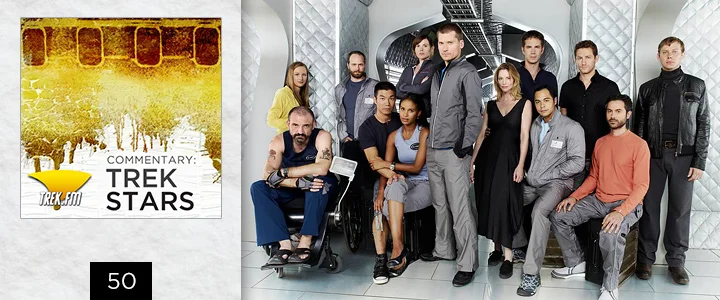
After five and a half years of running the Sci-Fi Channel's most successful series, Ronald D. Moore began development on not one, but two new pilots. The first was Caprica, as discussed last week. The second was a science fiction show for Fox titled Virtuality.  

Co-created by Trek writer Michael Taylor, Virtuality follows the crew of a spacecraft on a ten-year mission to find an alternative to life on Earth, which only has 100 years left. The crew, which is being filmed for a reality television show, relaxes with the help of a virtual reality program. However, the program has turned dangerous, and it may not be the result of a simple glitch.

This week, Max and Mike take a look at the pilot. We discuss wether or not the answers to the questions asked would have been satisfying, why Moore chose to develop two virtual reality shows simultaneously, and how Moore assembled his crew, made up of past collaborators. We also wonder why Jamiroquai wasn't hired to perform the theme song. 

cts-050-th-720.jpg

Commentary: Trek Stars 49: How Much is Too Much Adama? by TFM

Moore, Part 5: Caprica.

As the saying goes, "All of this has happened before, and all of it will happen again." While Ronald D. Moore's Battlestar Galactica was coming to a close, his new series, Caprica, was just beginning. 

The prequel takes a look at the world of BSG fifty years prior to its destruction. It focuses on two families, the Graystones and the Adamas, at a critical time in the history of the world, when artificial intelligence is on the brink of sentience. 

This week, Mike and Max are joined by their Commentary Track Stars: Off Topic co-host, Branden Myers, to look at the ill-fated spinoff. We discuss the problems with creating a prequel, how to make something different, and why the decision was made to change showrunners mid-season. We also debate whether or not the series should have been more like Desperate Housewives

cts-049-th-720.jpg

Commentary: Trek Stars 48: What Letters the Hell Were BSG? by TFM

Moore, Part 4: Battlestar Galactica. 

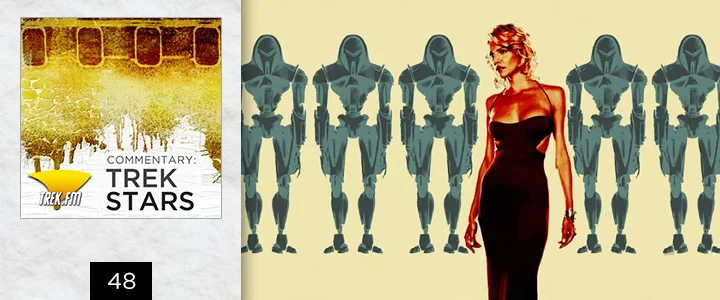
In many ways the nine years that Ronald D. Moore spent working on Star Trek prepared him for the show that very well may be his masterpiece, Battlestar Galactica. 

With his 2003 reboot of Glen A. Larson's classic series, Moore pushed boundaries that he wasn't allowed anywhere near on Star Trek. The end result is a heavily continuity-driven show that takes a hard look at politics, religion, and the human condition. 

This week, Max and Mike are joined by their co-host on Commentary Track Stars: Off Topic, Branden Myers, to take a look at one of the most significant science fiction works of the new millennium. We discuss what makes BSG stand out from other shows, how it differs from the original series, and the debt it owes to Star Trek. We also try to figure out whether or not Branden's a Trekkie.

cts-048-th-720.jpg

Commentary: Trek Stars 47: We Can't Have Nice Things by TFM

Moore, Part 3: Carnivale.

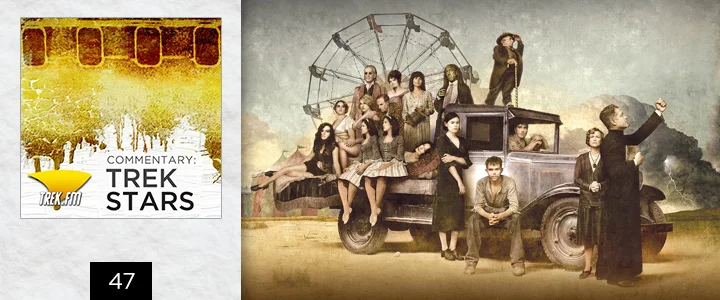
A year after the cancellation of Roswell, Ronald D. Moore returned to television to run a new HBO series titled Carnivale.

Set against the backdrop of a traveling carnival during the Great Depression, the show follows two people—Ben (played by Nick Stahl) and Justin (played by Clancy Brown)—who are unknowing pawns in a battle between good and evil.

This week, Mike and Max chat about Moore's first solo effort. We discuss how the series came to be, why Moore left after one season, and what the show's existence means for the future of television. We also debate whether or not the terms "good" and "evil" apply to the main characters.

cts-047-th-720.jpg

Hosts

Mike Schindler and Max Hegel


Chapters

Thoughts on Carnivale
Moore's Opinion of  the Show
Final Thoughts


Sponsor

Squarespace is the all-in-one platform that makes it fast and easy to create a professional website, blog, portfolio, online store, or anything else you can imagine!

Create your own space today and get the best hosting and CMS available anywhere—and support Trek.fm at the same time! Just visit squarespace.com and create your free 14-day trial. No credit card required! Then use offer code TREK9 to receive 10% off your lifetime purchase on new accounts! 


More recent episodes of Commentary: Trek Stars…

Commentary: Trek Stars
Commentary: Trek Stars 182: Let's See What's Out There

Series Finale. Mike and John reflect the past three and a half years of podcasting.

Commentary: Trek Stars 181: Deep Cuts

Lin, Part 8: Recap. Mike and John recap their series on Justin Lin.

Commentary: Trek Stars 180: Faster, More Intense

Lin, Part 7: Furious 6. John and Mike are joined by Megan from Educating Geeks to discuss Justin Lin's Furious 6.

Commentary: Trek Stars 46: Oopin it Up On the Dubba-Dubba-WB! by TFM

Moore, Part 2: Roswell.

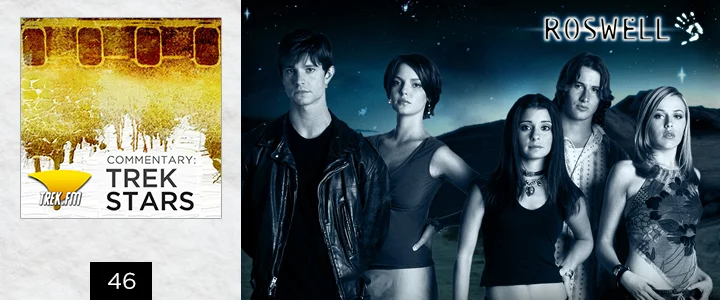
After leaving Voyager, Ronald D. Moore was recruited by Jason Katims to work on the second season of Roswell. The series chronicles the lives of three teenaged aliens who are secretly living in the town where their spacecraft crash landed. 

Under Katims’s leadership, the first season of Roswell was primarily character driven, with the science fiction elements taking a back seat. But going forward, the network wanted the series to build upon its sci-fi mythology. And so, Moore was hired as a co-showrunner for the first time in his career. 

This week, Max and Mike are joined by Trek.fm’s Christopher Jones to take a look at the final two seasons of Moore’s first show. We discuss whether or not Moore’s contribution improved the show, how well the show holds up over time, and the strange connection the show has to Enterprise. We also fondly recall now-defunct ’90s television networks.

cts-046-th-720.jpg

Commentary: Trek Stars 45: Who the Frak is Ringo? by TFM

Moore, Part 1: Star Trek.

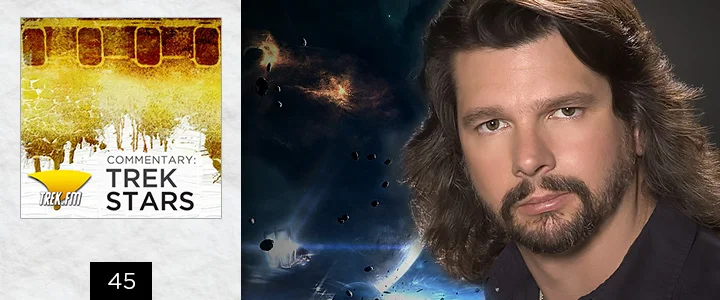
Many of the writers who began their careers on Star Trek have gone on to find great success outside of the franchise. But none have been more critically acclaimed than Ronald D. Moore. At the age of 25, Moore wrote his first teleplay, “The Bonding,” a spec script which was bought by Michael Piller for The Next Generation. He was quickly brought on staff, where he would write 60 more Trek adventures—including episodes for Deep Space Nine and Voyager, as well as the first two Next Generation movies.

This week, Mike and Max are joined by Matthew Rushing of The Orb to look at Moore’s work on Star Trek. We discuss his early work on The Next Generation, how his movies stack up to the others, what his contribution was to Deep Space Nine, and what led to his quick departure from Voyager. We also try to figure out who the Ringo of the DS9 writing staff was.

cts-045-th-720.jpg

Commentary: Trek Stars 44: Fighting Off Vampires, Post-Apocalyptically and Whatnot by TFM

Matheson, Part 10: Recap.

Richard Matheson’s influence on science fiction cannot be measured. Whether it’s I Am Legend or The Twilight Zone, Matheson’s impact on what has come since is massive.

This week, Max and Mike try to examine Matheson’s career by looking at a tiny cross-section of his work. Specifically, we recap our series on Matheson’s novels that have been adapted into movies. Starting at the beginning, we look at the books, Someone is Bleeding, I Am Legend, The Shrinking Man, A Stir of Echoes, Ride the Nightmare, Hell House, Bid Time Return, and What Dreams May Come, and their motion picture counterparts, Georges Lautner’s Icy Breasts, Sidney Salkow’s The Last Man on Earth, Boris Sagal’s The Omega Man, Francis Lawrence’s I Am Legend, Jack Arnold’s The Incredible Shrinking Man, Joel Schumacher’s The Incredible Shrinking Woman, David Koepp’s Stir of Echoes, Terence Young’s Cold Sweat, John Hough’s The Legend of Hell House, Jeannot Szwarc’s Somewhere in Time, and Vincent Ward’s What Dreams May Come. We also touch on our trip to the Parsec Awards.

cts-044-th-720.jpg

Commentary: Trek Stars 43: First HOOK, Now This! by TFM

Matheson, Part 9: What Dreams May Come.

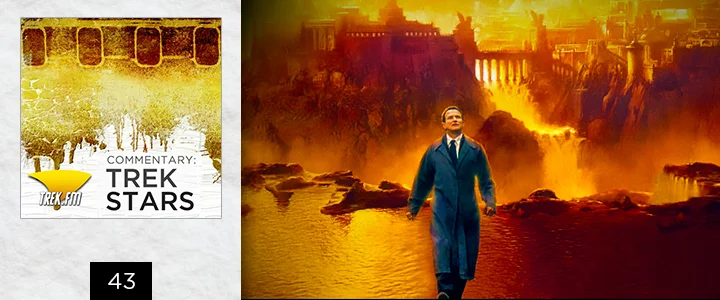
For his tenth novel, Richard Matheson continued to steer away from the horror genre and towards something more romantic in nature. An unofficial companion piece to Bid Time Return, What Dreams May Come tells the story of a dead man who embarks on a journey through hell to find his wife. Of all his novels, Matheson considers it to be his best work.

Twenty years after the release of the book, Vincent Ward adapted What Dreams May Come into a film starring Robin Williams. It was met with mixed reviews, though often applauded for its visual depiction of the afterlife.

This week, Mike and Max are joined by John Mills of Words with Nerds to discuss both Matheson’s novel and Ward’s movie. We discuss the meticulous detail of the book, debate whether or not the changes made in the film were effective, and wonder if Matheson’s motivations for writing the book were domestic in nature.

cts-043-th-720.jpg