Commentary: Trek Stars 22: A Tragedy of Alien Biblical Proportions by TFM

Lindelof Part 3: Prometheus.

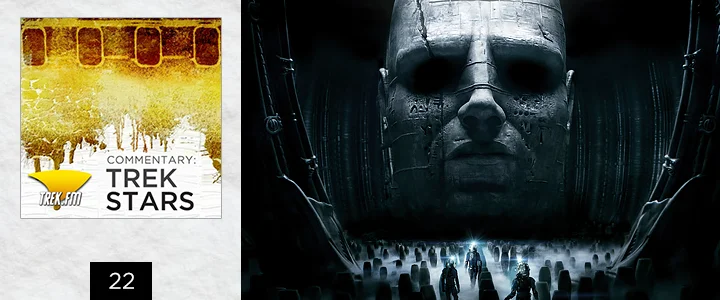
23 years after his groundbreaking film Alien, Ridley Scott returned to the beloved franchise with Prometheus. He hired Damon Lindelof to re-write Jon Spaihts’s original screenplay. With Lindelof, the movie became less of a prequel to Alien, and more of a standalone story inside of that universe.

This week, Max and Mike are joined by Mehul to talk about Lindelof’s second feature film. We discuss whether or not Prometheus lived up to the expectations of Alien fans, its depiction of science, the differences between the Spaihts and Lindelof drafts of the screenplay, Scott’s influence over the writers, the intention behind distancing Prometheus from the rest of the franchise, and the career path that Scott has taken in later years.
cts-022-th-720.jpg

Commentary: Trek Stars 21: Cold Fast Food by TFM

Lindelof Part 2: Cowboys & Aliens.

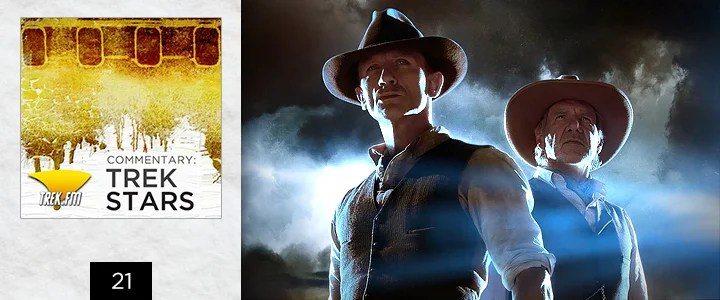
Following the conclusion of his hit television series Lost in 2010, Damon Lindelof made the jump to the big screen in 2011 with Jon Favreau’s Cowboys & Aliens. The script, which was Lindelof’s first, was co-written with his Star Trek collaborators Roberto Orci and Alex Kurtzman. The film stars Daniel Craig as a wanted man in the old west who wakes up with an unusual piece of technology on his wrist, and no memory of who he is. Craig is forced to team up with a rancher, played by Harrison Ford, in order to fight an alien menace that has been abducting the town’s citizens.

This week, Mike and Max are joined by John Mills of Words with Nerds to talk about Lindelof’s debut screenplay, and how it relates to his career on the whole. We discuss how Lindelof’s collaborations compare to his solo work, what makes Harrison Ford’s movies so special, why the film did not live up to expectations, who is to blame for the movie’s failure, where Lindelof’s touch is visible in the film, how Lindelof’s movie work differs from his television work, and whether or not it’s reasonable to be disappointed by a movie called Cowboys & Aliens.

cts-021-th-720.jpg

Commentary: Trek Stars 20: Bustin' Lindelof's Chops by TFM

Lindelof Part 1: Trek.

In 2007, J.J. Abrams was handed the keys to the Star Trek franchise. He quickly assembled a “Supreme Court” of collaborators which included writers Alex Kurtzman and Roberto Orci, executive producer Bryan Burk, and producer Damon Lindelof.

With Lindelof’s background as a television writer, most notably the creator of Lost, it was clear that his role on Star Trek would be a creative one. With Lost now behind him, Lindelof has joined Kurtzman and Orci as the franchise’s newest writer for Star Trek Into Darkness.

This week, Max and Mike begin a new series on Lindelof’s career as a movie writer. In Part 1, we are joined by Robert Reyes to look at Lindelof’s work in Trek. We discuss Lindelof’s time on Lost, Abrams’s reasons behind hiring Lindelof as a producer on Star Trek, whether or not the 2009 film lives up to the standards of the franchise, why the Lost team was chosen to reboot Trek, what our expectations are for Into Darkness, and of course, whether or not the new film’s villain is Khan.

cts-020-th-720.jpg

Commentary: Trek Stars 19: A Love for Lovecraft's Craft by TFM

Wilkerson Part 2: Houdini & Lovecraft, The Ghost Writer.

This week, Mike and Max are joined once again by Star Trek writer Ron Wilkerson to discuss his new novel, Houdini & Lovecraft, The Ghost Writer. In the book, the great illusionist Harry Houdini teams with the struggling writer H.P. Lovecraft to investigate a supposedly haunted house.

In this episode, Ron talks about the origins of the novel, creating a fictional dynamic between two real-life characters, the struggle of building interest in the book among Star Trek fans, working in the sci-fi horror genre, the inspiration of Lovecraft’s work on his own, his fascination with Houdini, the differences between writing for screenplays and novels, the new book he’s working on called Crossover, and the new television show he’s working on called Dreamland.

cts-019-th-720.jpg

Commentary: Trek Stars 18: Defending the Cheese Element by TFM

Wilkerson Part 1: Trek.

This week, Max and Mike are joined by Star Trek writer Ron Wilkerson in the first of two very special episodes.

Ron has written seven hours of Star Trek, including “Imaginary Friend,” “Schisms,” “Lessons,” and “Lower Decks” for The Next Generation, and “Learning Curve,” “Fair Trade,” and “Ashes to Ashes” for Voyager. He has also written a new novel entitled Houdini & Lovecraft, The Ghost Writer, which is available on Amazon.com.

In this episode, Ron tells us about his work on Star Trek, including the origins of “Lessons,” building stories around pre-existing characters and elements, collaborating with other writers, having his scripts re-written by others and re-writing other people’s scripts himself, tackling the issue of Maquis integration, what his relationship was with Star Trek growing up, and what he thinks about the current incarnation of the franchise. We also discuss how it is perfectly reasonable to get the cheese to sickbay.

cts-018-th-720.jpg

Commentary: Trek Stars 17: A Retrospectival by TFM

Meyer Part 8: Recap.

While Nicholas Meyer may be best known for his career in film, he is also a rather prolific author. Over the past seven weeks, Mike and Max have covered all six of Meyer’s novels, and this week we recap his writing career on the whole. We touch on each of his novels, including Target Practice, The Seven-Per-Cent Solution, The West End Horror, Black Orchid, Confessions of a Homing Pigeon, and The Canary Trainer, and try to draw some conclusions on his career on the whole. 

cts-017-th-720.jpg

Commentary: Trek Stars 16: Infected with Literary Curiosity by TFM

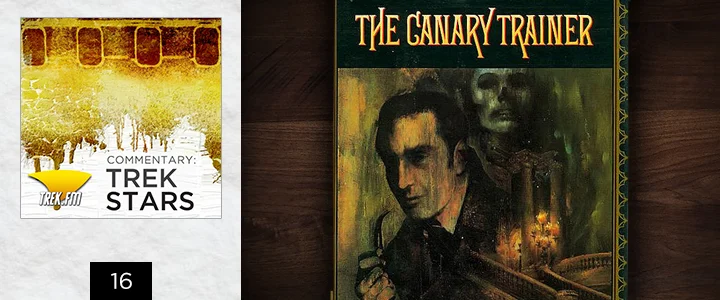
Meyer Part 7: The Canary Trainer.

After a twelve year hiatus, Nicholas Meyer returned to the medium of books for one last novel in 1993. Once again, he chose to tackle the character of Sherlock Holmes. The Canary Trainer looks at what happened to Holmes after The Seven-Per-Cent Solution, where we find him in Paris on the case of The Phantom of the Opera.  

This week, Max and Mike are joined by Augie Aleksy of Centuries & Sleuths Bookstore in Forest Park, Illinois, to discuss what Holmes was up to during The Great Hiatus, How Meyer fits his story inside of both Arthur Conan Doyle’s canon and Gaston Leroux’s novel, how the character of Holmes works without Watson, and how Meyer’s books encourage readers to seek out their source material.

cts-016-th-720.jpg

Commentary: Trek Stars 15: Just Like Batman & Robin by TFM

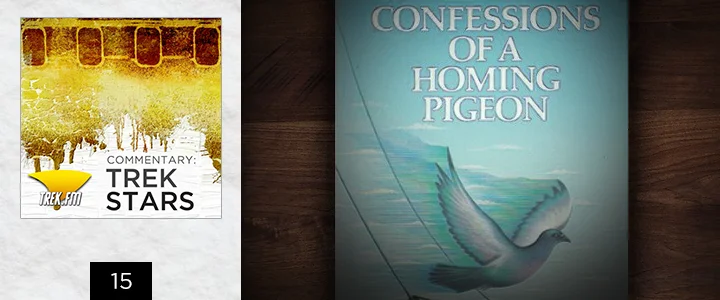
Meyer Part 6: Confessions of a Homing Pigeon.

After a string of successful mystery and adventure books, Nicholas Meyer chose to tell a more personal story for his fifth novel, Confessions of a Homing Pigeon. The book is an autobiographical coming of age tale about George Bernini, an American boy who is sent to France to live with his alcoholic Uncle Fritz after his parents are killed in a trapeze accident.

This week, Mike and Max discuss the personal nature of the novel and how it deals with universal themes of adolescence, the reasons why Meyer felt compelled to tell this story, the similarities to Catcher in the Rye, how the book works as a road story, how this novel’s style differs from Meyer’s other novels, whether or not the book suffers from “The Dawson’s Creek Syndrome,” why the 14-year-old protagonist reminds Mike of Roy Scheider, what makes this book Meyer’s Driving Miss Daisy, and how the book is essentially the story of Robin the Boy Wonder gone wrong.

cts-015-th-720.jpg

Commentary: Trek Stars 14: Less Botany, More Botany Bay by TFM

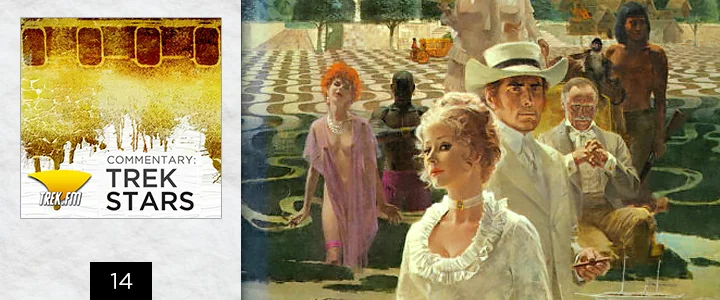
Meyer Part 5: Black Orchid.

In 1977, Nicholas Meyer teamed up with his University of Iowa classmate Barry Jay Kaplan to write his fourth novel, Black Orchid. The book was Meyer’s first attempt at something outside of the mystery genre, specifically historical fiction. It looks at the Brazilian Rubber Boom of the late Nineteenth Century, and the United Kingdom’s attempt to steal rubber seeds in the hopes of breaking up Brazil’s rubber monopoly.

This week, Max and Mike are joined by Matt Rushing of Trek.fm’s Literary Treks and The Orb to discuss the book’s strengths and weaknesses, whether or not Kaplan’s influence hurt the overall work, the protagonist’s similarities to Indiana Jones, the real life history behind the fiction, the inherent drama of seed-stealing espionage, the finale’s similarities to the Battle of the Mutara Nebula, and why The Undiscovered County is the perfect title for Star Trek VI.

cts-014-th-720.jpg

Commentary: Trek Stars 13: A Fan Club on Steroids by TFM

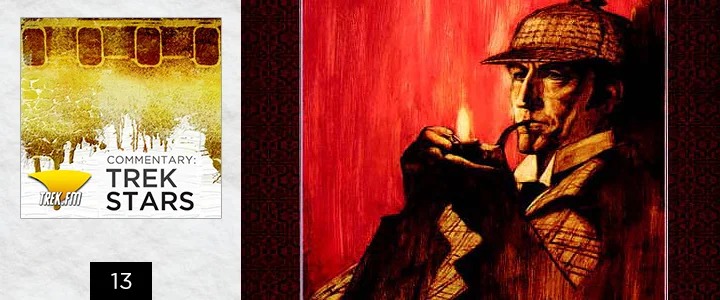
Meyer Part 4: The West End Horror.

Two years after the success of The Seven-Per-Cent Solution, Nicholas Meyer returned with his second Sherlock Holmes novel, The West End Horror. This time, Meyer chose to write a much more traditional Holmes adventure which features the detective investigating a murder set against the backdrop of the British theater scene of the late 19th century.

This week, Mike and Max are joined by Tony Powers, a public librarian and Holmes aficionado, to discuss how Sherlockians compare to Trekkies, how Meyer’s books stack up against other Holmes pastiches, how the story is used to shed light on various historical characters of the era, the difficulties of simultaneously satisfying both the long-time fan and the newcomer, the passion of the Baker Street Irregulars, the work of Holmes scholar William Baring-Gould, and Meyer’s ability to stay true to source material while adapting it for a modern audience.

cts-013-th-720.jpg