Commentary: Trek Stars 62: A Pretty Cool Nerd by TFM

Behr, Part 5: Alphas.

In 2011, Ira Steven Behr returned to the science fiction genre with Alphas. The series followed a group of super-powered mutants who helped the government solve crimes while coping with their unique abilities. 

This week, Max and Mike are joined by their Commentary Track Stars: Off Topic co-host Branden Myers to take a look at Behr's sixth show. We discuss the similarities to The X-Men, how the tone differs from other SyFy Channel shows, and the Behr-less second season. We also touch on Ronald D. Moore's recent Twitter activity, and the passing of Trek producer Marty Hornstein.

cts-062-th-720.jpg

Commentary: Trek Stars 61: Taking Our Glasses Off by TFM

Behr, Part 4: Crash.

After a less than successful first season, the Starz Network decided to give their television show Crash a second chance. It was decided that the series needed to be reinvented, and that the man for the job was Ira Steven Behr. 

This week, Mike and Max take a look at the second season of Crash. We discuss the changes that were made to the show, how the issue of racism is dealt with, and why we'll always give Behr the benefit of the doubt.

cts-061-th-720.jpg

Commentary: Trek Stars 60: They Got ALFed! by TFM

Behr, Part 3: The 4400.

In 2004, Rene Echevarria and Scott Peters created The 4400. In the show, 4,400 missing persons from the past century spontaneously return with superpowers. Echevarria quickly handed over the writing staff to his Trek boss, Ira Steven Behr, who ran the series until its cancellation in 2007.

This Week, Max and Mike are joined by Trek.fm's very own Christopher Jones to talk about Behr's fourth show. We discuss the religious parallels of the story, the character development over time, and the moral ambiguity of the situations presented in the series.

cts-060-th-720.jpg

Commentary: Trek Stars 59: Like Jordan Playing Hungry Hungry Hippos by TFM

Behr, Part 2: The Twilight Zone. 

Perhaps the only science fiction television franchise which is more critically acclaimed than Star Trek is Rod Serling's The Twilight Zone. And the only person in history who has run shows in both franchises is Ira Steven Behr.

This week, Mike and Max are joined by Tom Elliot of The Twilight Zone Network to look at Behr's third series, the 2002 incarnation of The Twilight Zone. We discuss how Behr's series compares to the original, the idea of a cohesive Twilight Zone multiverse, and what we can expect from future incarnations of the show.  We also debate whether or not the Steve Guttenberg vehicle Tower of Terror takes place in the Twilight Zone.

cts-059-th-720.jpg

Commentary: Trek Stars 58: Ira-ocity by TFM

Behr, Part 1: Trek. 

During the third season of Star Trek: Deep Space Nine, Michael Piller "stepped back" from his daily duties and handed the writing staff to his Number One—Ira Steven Behr. It was at this point that Deep Space Nine went from being a great show to being the best show. Ever. 

This week, we begin a new series looking at Behr's career as a showrunner. In Part 1, Max and Mike are joined by Larry Nemecek to look at Behr's work on Star Trek. We discuss his origins on The Next Generation, how Piller lured him back to work on Deep Space Nine, and how he predicted fans would appreciate the show in later years. We also talk about how baseball was responsible for the best of Trek.

cts-058-th-720.jpg

Commentary: Trek Stars 57: Stubborn as a Cyborg Donkey by TFM

Ellison, Part 4: Recap.

Few writers are as prolific as Harlan Ellison. But perhaps his greatest contribution to the world of sci-fi is his commentary on the genre itself. This week, Mike and Max recap Ellison's work on The Outer Limits. We look at his two episodes, "Soldier" and "Demon with a Glass Hand," as well as his episode of Star Trek, “The City on the Edge of Forever." We also discuss his career outside television, and his impact as a public figure in the sci-fi community.

cts-057-th-720.jpg

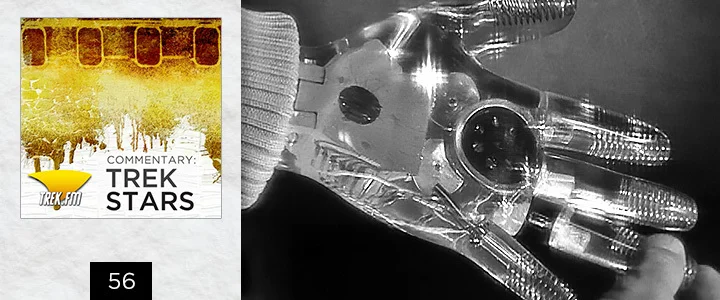
Commentary: Trek Stars 56: God Bless Sumerica by TFM

Ellison, Part 3: Demon with a Glass Hand.

In 1964, Harlan Ellison won the Writer’s Guild of America Award for his second entry into The Outer Limits, “Demon with a Glass Hand.” The episode tells the story of a man with a computer hand who is humanity’s last hope in an intergalactic war. This week, Max and Mike are joined by Tysto of Tysto.com to look at “Demon with a Glass Hand.”  We discuss why it is so acclaimed, how it is part of a much larger story, and how it might have tied into Babylon 5. We also talk about how awesome The Sci-Fi Buzz was.

cts-056-th-720.jpg

Running Time: 38 minutes 20 seconds


Hosts

Mike Schindler and Max Hegel


Guest

Tyco


Show Notes

Check out Tysto’s audio commentaries at tysto.com.


Chapters

Demon with a Glass Hand
The Episode’s Influence
The Earth-Kyba War
The Bradbury Building
Final Thoughts


Sponsor

Audible is the premiere source for audiobooks with more than 150,000 titles to choose from, and new titles coming every week. From classics to current bestsellers, and even some of the most famous Star Trek books like Prime DirectiveFederation, and Spock’s World, Audible has something for everyone.

As a Trek.fm listener you can get a free audiobook of your choice along with a 30-day trial to see just how great Audible is. So give it a try today, catch up on all those classic Star Trek books you’ve yet to read or that latest novel from you favorite author and support the network and our programming at the same time! Just go to audibletrial.com/trekfm and sign up today.


More recent episodes of Commentary: Trek Stars…

Commentary: Trek Stars 55: Klingon Small Wonder by TFM

Ellison, Part 2: Soldier.

In 1964, the cult sci-fi show The Outer Limits was renewed for a second season. The new production team decided to shift the focus away from a "monster of the week" format, and into a "hard sci-fi" direction. As part of this change, Harlan Ellison was brought in to write two episodes of the anthology series.

The first of these was “Soldier,” based on his own short story entitled “Soldier from Tomorrow.” As the title suggests, it tells the story of a soldier from a future war, played by Michael Ansara, who is thrown back in time to the strange land of America in the mid-20th century.

This week, Mike and Max take a look at both “Soldier” and the story upon which it's based. We discuss The Outer Limits in general, the episode in particular, and the allegations of plagiarism which Ellison brought against James Cameron's The Terminator. We also look back at the Shatner-starring, Esperanto-speaking opus which is Incubus.

cts-055-th-720.jpg

Commentary: Trek Stars 54: The Citizen Kane of Star Trek by TFM

Ellison, Part 1: Trek.

This week, Max and Mike begin a new series on writer Harlan Ellison, looking at his work on The Outer Limits.

Ellison's “The City On the Edge of Forever” is considered by many to be Star Trek's finest hour. The story of Kirk finally falling in love, only to have that love snatched away by the Universe is both epic in scale and personal in emotion. It is thought of by most to be a masterpiece. But not by Ellison.

The episode's road to the screen was undoubtedly the most troubled of any Trek episode. Ellison's original screenplay was thought to be unfilmable and uncharacteristic of Trek. As such, it was heavily rewritten by Gene Roddenberry and others, until it became something that Ellison despised. Three decades later, Ellison published his original screenplay along with an essay telling his side of the story. The book is almost as epic as the episode itself.

For the first part in our series on Ellison, we are joined by Drew Stewart of Standard Orbit and John Mills of Words with Nerds to look at both the finished episode and the original screenplay. We discuss whether or not it is the best episode of Trek, how the aired version differs from the first draft, whether or not the changes are for the better, and what Ellison's essay says about the creative process.
cts-054-th-720.jpg

Commentary: Trek Stars 53: Kung Fu Vulcan by TFM

Black & Cushman, Part 2: Star Trek & These are the Voyages.

Only months after publication, Marc Cushman's These are the Voyages is already considered to be the most thorough insight into the making of Star Trek: The Original Series. With 500 pages dedicated to Season One and two more volumes on the way, it is quite clearly the definitive history of Gene Roddenberry's classic show.

In our third season premiere, Mike and Max present the second half of their interview with Marc and Original Series veterans John D.F. & Mary Black. We talk about how television has changed since the sixties, what other movies and shows John has written, and what we can expect to see in the next two volumes of These are the Voyages. We also ponder what it would have been like if Spock had left after Season One.

These are the Voyages, TOS, Season One can be purchased now on Amazon.com, with Seasons Two and Three set for release in the coming months.

cts-053-th-720.jpg